AI for DevOps: How Artificial Intelligence Is Reshaping Software Delivery
From predictive monitoring to auto-remediation, AI is turning DevOps from reactive firefighting into proactive, intelligent operations. Here's how it works, and where it's headed.
DevOps was built on a simple promise: break down the wall between development and operations so software ships faster and more reliably. For years, that promise was fulfilled through automation, CI/CD pipelines, infrastructure as code, containerization, and monitoring dashboards. But a new force is now accelerating that evolution even further: Artificial Intelligence.
AI is no longer a buzzword confined to data science teams. It’s actively reshaping how engineering teams build, test, deploy, and maintain software. This shift even has its own name, AIOps (Artificial Intelligence for IT Operations), and it’s quickly becoming a core pillar of modern DevOps practice.
Picture a typical on-call engineer at 2 a.m., paged because a service’s latency spiked. In the old world, they’d sift through dashboards, correlate logs by hand, and guess at a root cause while half asleep. In an AI-augmented DevOps environment, much of that triage already happened before the page even went out, the system identified the anomaly, correlated it with a recent deployment, and suggested (or executed) a fix. That shift, from manual firefighting to AI-assisted operations, is what this post is about.
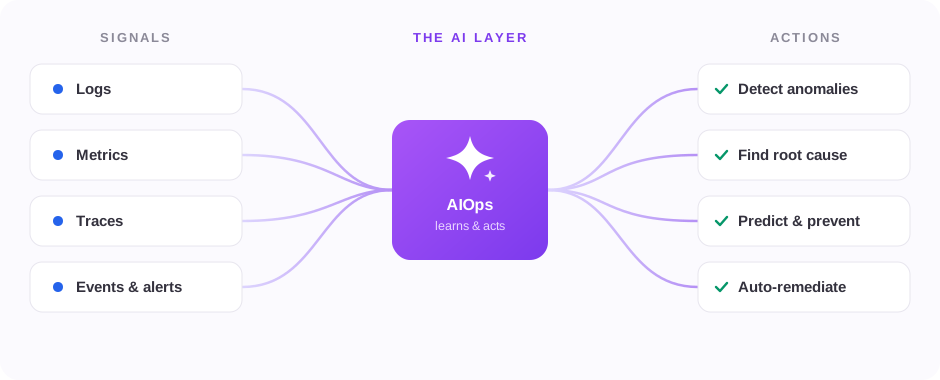
How AIOps works: raw operational signals feed an AI layer that turns them into action.
Why DevOps Needs AI
Modern software systems have grown incredibly complex. A single application might span dozens of microservices, multiple cloud regions, and thousands of daily deployments. Humans simply can’t manually monitor, analyze, and react to every signal in real time. That’s where AI steps in, processing massive volumes of operational data, spotting patterns humans would miss, and taking action faster than any team could on its own.
DevOps has always been about speed, reliability, and collaboration. AI adds a fourth dimension: intelligence at scale. It lets pipelines learn from history, lets monitoring systems understand context instead of just thresholds, and lets teams shift from reactive firefighting to proactive prevention.
Key Areas Where AI Is Transforming DevOps
1. Intelligent CI/CD Pipelines
Continuous Integration and Continuous Delivery pipelines generate huge amounts of historical data, build times, test results, failure patterns, deployment outcomes. AI can mine that data to predict which code changes are likely to break a build, prioritize test cases based on risk rather than running the full suite every time, and flag flaky tests that waste engineering time. Some platforms even use AI to auto-heal broken pipelines by identifying the likely cause of a failed step and retrying with a fix applied. The net effect is shorter feedback loops and faster, more confident releases.
2. Predictive Monitoring and Anomaly Detection
Traditional monitoring relies on static thresholds, alert if CPU usage crosses 80%, for example. The problem is that “normal” behavior varies wildly by time of day, season, or feature launch, which means static thresholds generate either too many false alarms or miss real problems entirely. AI-driven observability tools instead learn what normal looks like for each specific system and flag subtle deviations before they escalate into outages. This is often called predictive monitoring, and it can give teams hours of advance warning instead of a sudden 3 a.m. page.
3. Automated Incident Response
When something does break, speed matters. AI can correlate logs, metrics, and distributed traces across dozens of services to quickly pinpoint the root cause instead of leaving engineers to manually stitch together the story. Some platforms go a step further with auto-remediation, automatically restarting failed containers, scaling up starved resources, or rolling back a bad deployment without waiting for a human to wake up and approve it. This directly reduces two of the most important DevOps metrics: Mean Time to Detect (MTTD) and Mean Time to Resolve (MTTR).
4. Smarter Infrastructure Management and Capacity Planning
AI-powered capacity planning tools forecast resource needs based on historical traffic patterns, seasonal trends, and even marketing calendars. This enables proactive auto-scaling instead of reactive scaling that kicks in only after users are already experiencing slowdowns. It also means fewer over-provisioned servers sitting idle and fewer surprise cloud bills at the end of the month, a discipline sometimes called FinOps, which increasingly overlaps with AI-driven DevOps practices.
5. AI-Assisted Infrastructure as Code and Configuration
Writing and maintaining Infrastructure as Code (IaC), Terraform modules, Kubernetes manifests, Ansible playbooks, CI/CD YAML, is powerful but time-consuming and easy to get wrong. AI coding assistants can now generate, review, and refactor these configuration files from natural language descriptions, catch misconfigurations before they reach production, and suggest best-practice patterns based on the rest of the codebase. This lowers the barrier for teams to adopt IaC properly and reduces the “it worked on my machine” class of problems that infrastructure drift causes.
6. Security and Compliance (DevSecOps)
Security can no longer be a final gate before release, it has to be woven throughout the pipeline, which is the whole idea behind DevSecOps. AI strengthens this by scanning code and infrastructure configurations for vulnerabilities as they’re written, detecting unusual access patterns that might indicate a compromised credential or insider threat, and continuously checking configurations against compliance frameworks rather than relying on periodic manual audits. Because AI models can process far more signals than a human reviewer, they catch subtle issues, like a slowly escalating pattern of unusual API calls, that traditional rule-based scanners often miss.
7. Chatbots and Conversational Interfaces for Ops
An emerging use case is the AI-powered ChatOps assistant, a chatbot integrated into Slack or Microsoft Teams that engineers can ask questions like “why did the payments service deploy fail last night?” and get an instant, context-aware answer pulled from logs, metrics, and deployment history. This reduces the time engineers spend digging through multiple dashboards and tools during an incident.
Popular Tools Leading the Charge
- Datadog & Dynatrace, AI-driven observability and anomaly detection across infrastructure and applications
- PagerDuty AIOps, intelligent incident response, alert correlation, and noise reduction
- GitHub Copilot, AI-assisted coding for scripts, pipelines, and IaC configuration files
- Harness, AI-powered CI/CD with automated verification, canary analysis, and rollback
- Moogsoft & BigPanda, event correlation platforms built specifically to cut alert fatigue
- Snyk, AI-assisted vulnerability scanning integrated directly into the development workflow
Benefits of Bringing AI into DevOps
- Faster incident resolution, AI cuts down both detection and resolution time significantly
- Reduced alert fatigue, smart correlation means fewer, more meaningful alerts instead of a flood of noise
- Higher deployment confidence, predictive testing and risk-based prioritization reduce failed releases
- Cost efficiency, better forecasting means smarter, more accurate resource allocation
- Proactive rather than reactive operations, teams fix problems before users ever notice them
- Freed-up engineering time, less time spent on repetitive triage means more time for actual engineering work
Challenges to Keep in Mind
AI isn’t a magic fix, and DevOps teams adopting AIOps still need to watch out for a few things:
- Data quality issues, AI models are only as good as the telemetry data feeding them; noisy or incomplete data leads to unreliable predictions
- Over-reliance on automation, critical, high-impact decisions still need human oversight and a clear rollback plan
- Integration complexity, stitching AI tools into existing CI/CD pipelines and monitoring stacks takes real engineering effort and isn’t always plug-and-play
- Skill gaps, teams need to build familiarity with AI-driven tooling, learn to interpret its outputs correctly, and know when to trust or override a recommendation
- Tool sprawl, adding multiple AI-powered platforms on top of an already complex DevOps toolchain can itself become a management burden
Building an AI-Ready DevOps Culture
Adopting AI for DevOps isn’t just a tooling decision, it’s a culture shift. Teams that succeed with it usually start small: introducing AI-assisted anomaly detection on one critical service before rolling it out fleet-wide, or letting an AI coding assistant handle IaC reviews before trusting it with auto-remediation. Clear observability foundations, well-labeled telemetry data, and strong incident postmortem practices all make AI tools more effective, because these systems learn from exactly the same signals that human engineers rely on.
The Road Ahead
As AI models become more capable, expect DevOps to move toward self-healing systems, infrastructure that not only detects problems but resolves them autonomously, learning and improving with every incident. The role of DevOps engineers won’t disappear; it will shift toward designing, training, and supervising these intelligent systems rather than manually firefighting every issue. Expect deeper integration between AI and platform engineering, more natural-language interfaces for managing infrastructure, and tighter feedback loops between security, development, and operations.
Final Thoughts
AI for DevOps isn’t about replacing engineers, it’s about giving them superpowers. By automating the repetitive, predicting the unpredictable, and surfacing insights buried in mountains of operational data, AI allows DevOps teams to focus on what matters most: building great software and delivering real value to users, faster and more reliably than ever before.
The organizations that embrace AI-driven DevOps today will be the ones setting the pace for software delivery tomorrow.